Key Takeaways
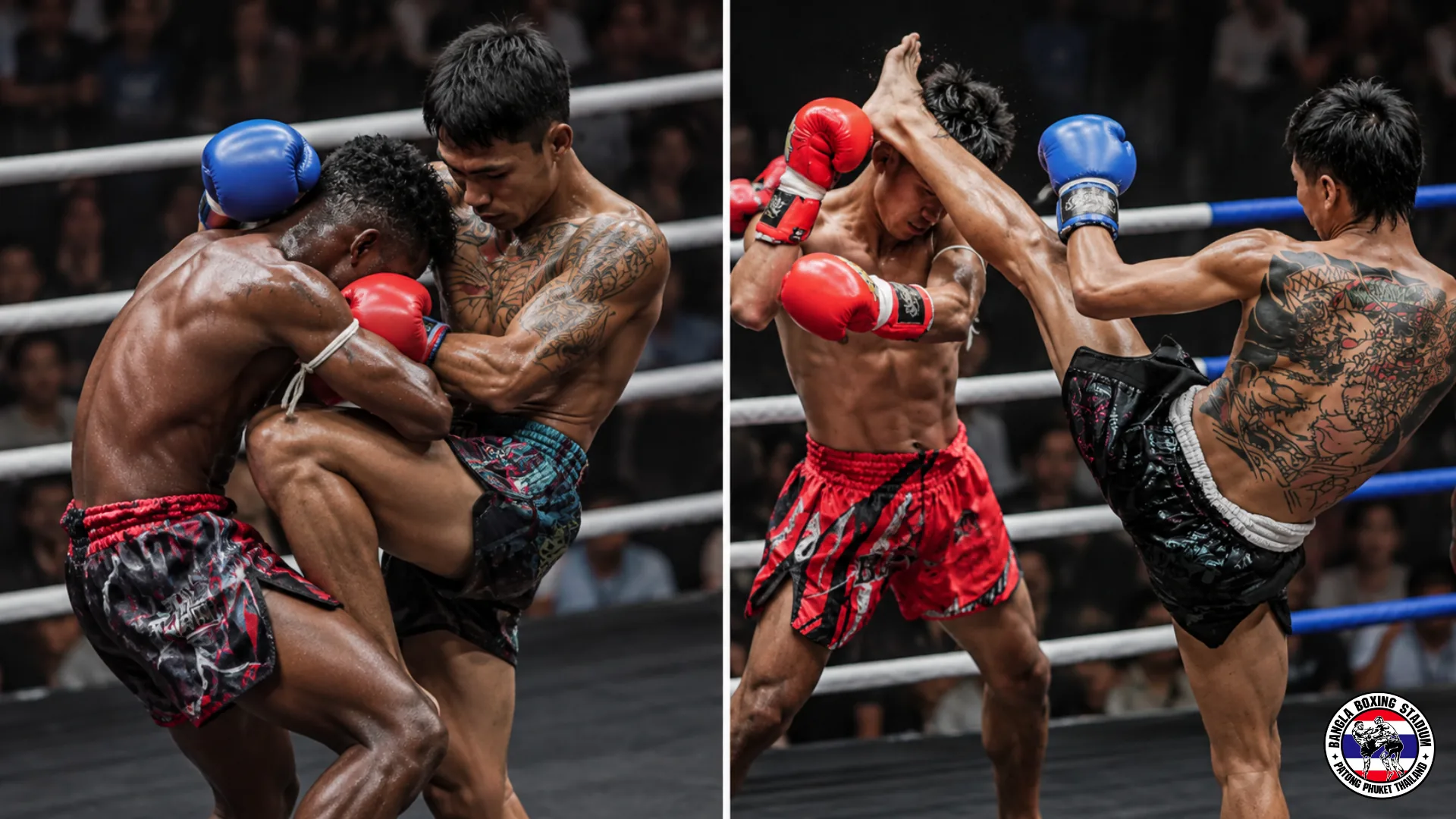
- In Muay Thai vs kickboxing, the fundamental difference lies in the striking arsenal: Muay Thai uses eight contact points including elbows, knees, and full clinching, whereas standard kickboxing relies on a four-point striking system of punches and kicks with elbows and extended clinches banned.
- Muay Thai kicks generate heavy concussive force by swinging the entire hip through the target with the dense shin bone, while many kickboxing styles favor faster, snapping kicks that flow into rapid combinations.
- Fight pacing reflects distinct scoring criteria: traditional Muay Thai starts methodically and builds momentum across five rounds, while kickboxing bouts are shorter and push continuous, high-volume combinations from the first bell.
- Authentic fight nights feature live traditional Sarama music and pre-fight rituals unique to Thai boxing culture, which you can experience every night at Bangla Boxing Stadium in Patong.
When travelers look for combat sports action in Phuket, they often ask about Muay Thai vs kickboxing and wonder if both sports are the same. While both disciplines share striking fundamentals inside a boxing ring, Muay Thai is Thailand’s national cultural heritage, whereas kickboxing developed as a modern combat sport with distinct rules.
Bangla Boxing Stadium brings international spectators ringside in Patong to witness authentic Muay Thai every night of the week. Understanding how Thai boxing separates itself from modern kickboxing will help you appreciate the real-time strategy, the impact of each strike, and the thrilling energy of a live fight night.
Table of Contents
- Key Takeaways
- The Main Difference Between Muay Thai and Kickboxing
- Muay Thai vs Kickboxing Elbows, Knees and the Clinch
- How the Kicks Differ in Muay Thai vs Kickboxing
- Muay Thai vs Kickboxing Scoring and the Pace of a Fight
- Rituals and Music You Only See in Muay Thai
- Where to Watch Muay Thai in Phuket
- Frequently Asked Questions About Muay Thai and Kickboxing
- Conclusion
The Main Difference Between Muay Thai and Kickboxing
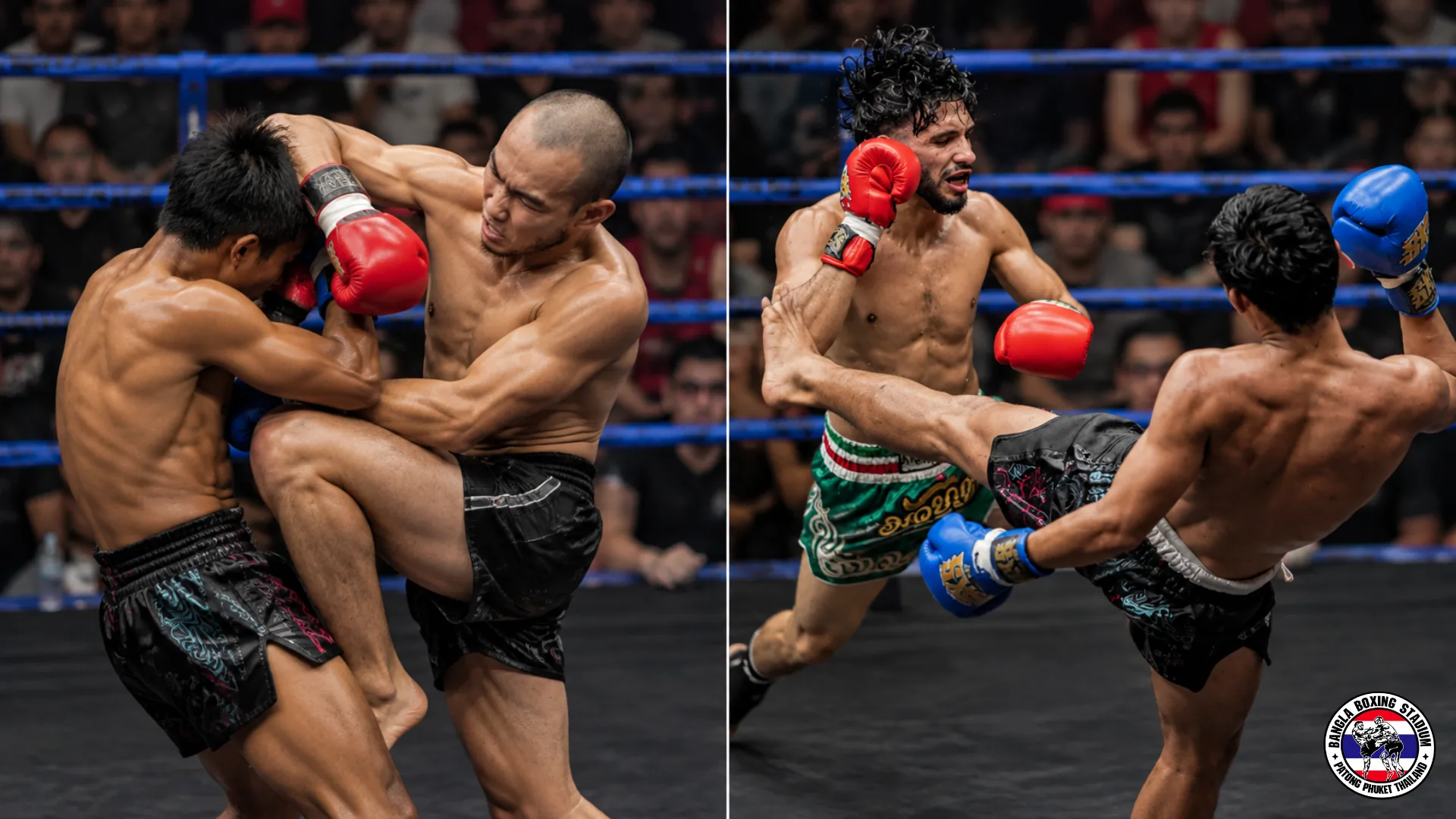
The main difference between Muay Thai and kickboxing is the striking system and close-range grappling: Muay Thai is an eight-limb martial art that allows punches, elbows, knees, kicks, and standing clinches, while kickboxing is a four-point sport restricted to punches and kicks with elbows banned and clinching broken almost immediately.
Spectators unfamiliar with stadium action often mistake the two styles because both athletes wear boxing gloves and compete inside a roped ring. However, western boxing gloves are where the equipment similarities end, as the tactical rules, offensive targets, and defensive postures create two completely separate sports.
| Feature | Muay Thai | Kickboxing |
|---|---|---|
| Striking System | 8 contact points (punches, elbows, knees, shins) | 4 contact points (punches, kicks/feet) |
| Elbow Strikes | Fully legal (slashing, spinning, downward) | Strictly banned in standard rules |
| Knee Strikes | Fully legal to body and head from any angle | Limited to single strikes or restricted by promotion |
| Clinching and Throws | Prolonged standing clinch, sweeps, and dumps legal | Clinch broken immediately by referee, throws banned |
| Kick Impact Surface | Hard lower shin bone swung with full hip rotation | Instep of foot or lower shin with snapping motion |
| Bout Duration | 5 rounds of 3 minutes with 2-minute rests | Usually 3 to 5 rounds of 3 minutes with 1-minute rests |
| Fight Music and Rituals | Live traditional Sarama band and Wai Kru pre-fight dance | Arena audio walkout music, no pre-fight rituals |
Muay Thai vs Kickboxing Elbows, Knees and the Clinch
Close-range combat represents the clearest dividing line in Muay Thai vs kickboxing. When two fighters close the distance inside the ring, their permissible weapons, defensive tactics, and grappling strategies shift entirely depending on the rule set sanctioned for the match.
The following breakdown highlights how close-range strikes, clinching rules, and inside tactics compare between both combat disciplines.
| Clinch & Striking Dynamic | Muay Thai | Kickboxing |
|---|---|---|
| Elbow Strikes | Fully legal from all angles (slashing, downward, spinning) | Strictly banned under standard competition rules |
| Knee Strikes | Continuous knees to the torso, ribs, and head | Limited to single strikes or completely restricted |
| Standing Clinch | Core offensive battleground for collar ties and control | Tactical foul; referee breaks clinch within seconds |
| Sweeps and Throws | Sweeps and off-balancing dumps from the clinch or caught kicks (hip throws are not allowed) | Strictly illegal; tripping or dumping draws penalty warnings |
| Inside Tactical Goal | Inflict heavy cuts, body fatigue, and off-balance opponents | Reset immediately to long-range punching distance |
The Eight Limbs of Muay Thai Versus the Four Points of Kickboxing
Muay Thai earns its title as the Art of Eight Limbs by turning the human body into a complete striking arsenal. Our guide to what Muay Thai is covers where that name comes from. Fighters deliver devastating damage at point-blank range using their elbows as blades and their knees as spears, creating high-risk exchanges that can cut or stop an opponent in seconds. In contrast, kickboxing vs Muay Thai comparisons show that kickboxing operates strictly as a four-point system limited to punches and kicks. Because kickboxing eliminates elbow strikes entirely and strictly restricts knee techniques, athletes must rely on rapid boxing combinations and distance kicks to build scoring volume.
How the Standing Clinch Dictates Close-Range Action
The standing clinch in Muay Thai functions as an intense grappling battle fought chest-to-chest. Competitors fight for inside collar ties around the back of the neck, manipulating an opponent’s head posture to drive knees into the ribs or dump them to the canvas with legal sweeps. When people compare kick boxing vs Muay Thai, the clinch is the clearest gap. In standard kickboxing, the referee separates fighters the second a clinch forms. Kickboxing rules prioritize continuous striking flow, meaning any attempt to tie up an opponent or execute a throw results in an immediate warning from the official.
How the Kicks Differ in Muay Thai vs Kickboxing
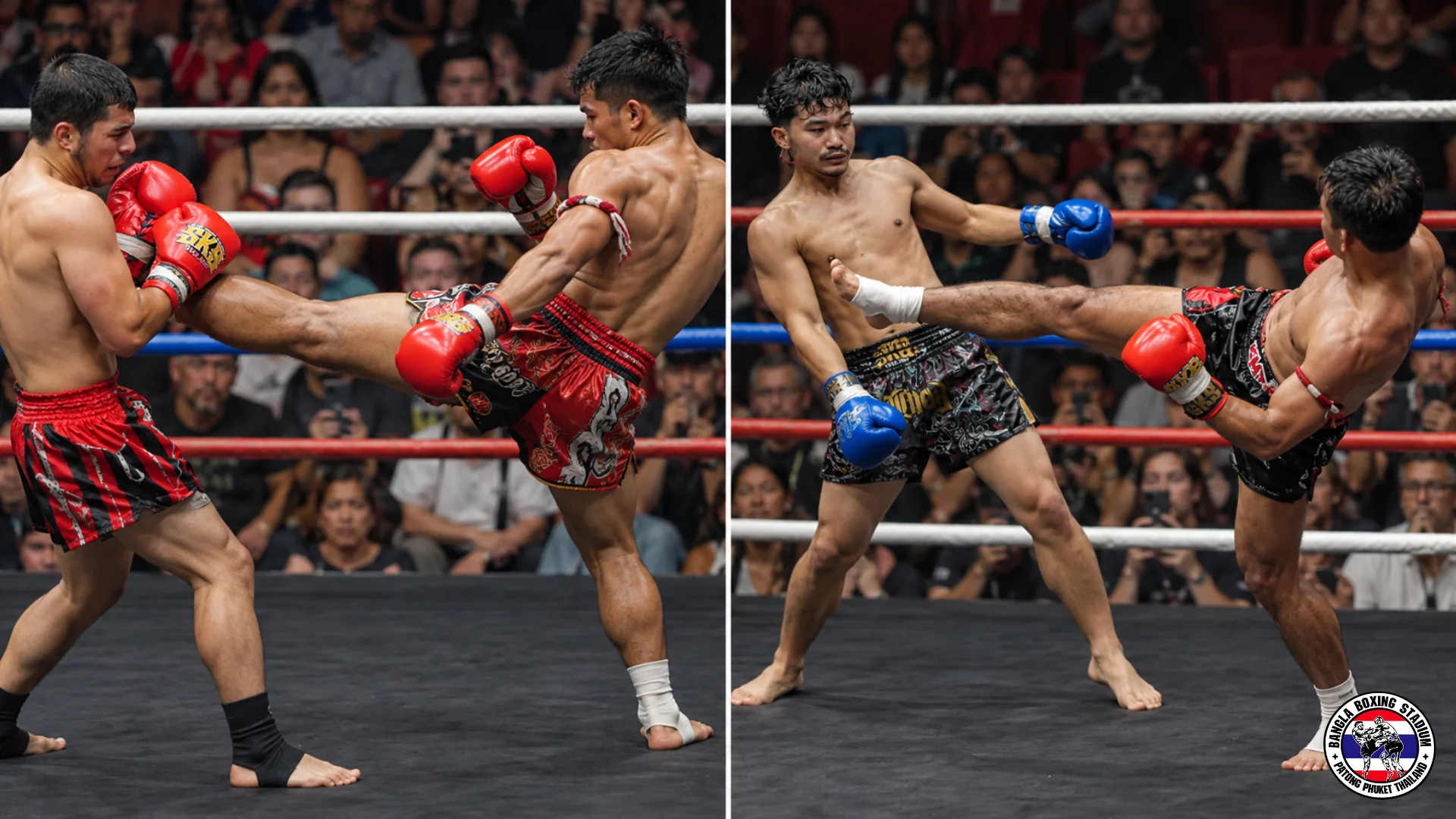
Although high, middle, and low kicks are central offensive weapons in Muay Thai vs kickboxing, the mechanical execution behind each strike looks and sounds completely different from ringside. The fundamental difference comes down to full rotational body weight versus rapid, snapping limb velocity.
Understanding how shins and feet deliver power explains why Thai kicks leave such an impression on first-time stadium spectators. Here is how kicking mechanics contrast across both arts.
| Kicking Characteristic | Muay Thai | Kickboxing |
|---|---|---|
| Primary Impact Bone | Dense lower third of the shin bone | Instep (top of foot) or lower shin |
| Delivery Mechanics | Full baseball-bat rotation swinging through the target | Chambered snapping delivery bending at the knee |
| Body Commitment | Full-body rotation prioritizing maximum concussive force | Upright stance prioritizing fast retraction and balance |
| Sound at Ringside | Heavy, resonant thud from bone-on-body collision | Sharp, snapping crack with high linear velocity |
| Tactical Application | Breaking opponent guard, bruising ribs, and deadening thighs | Fast multi-strike combinations flowing from punches |
Baseball Bat Shin Power in Muay Thai
Roundhouse kicks in Muay Thai behave like a swung baseball bat designed to break through an opponent’s guard. The Thai boxer steps across the centerline, swings their entire arm downward, and rotates their hips through the strike while connecting with the dense lower third of the shin bone. This full-body commitment sacrifices immediate recovery speed in exchange for concussive, bone-deadening power that bruises forearms, damages thighs, and shakes rib cages. Spectators sitting close to the ring will immediately hear the deep, echoing thud that accompanies every landed Thai kick.
Snapping Chamber Kicks in Kickboxing
Many kickboxing styles, especially those with karate roots, rely on chambering mechanics. A kickboxer raises the knee first to disguise the intended target, then snaps the lower leg outward to strike with the instep of the foot or the lower shin before whipping the foot back into a balanced boxing stance. This chambered delivery allows kickboxers to throw rapid multi-strike combinations that flow directly from punches into kicks. While individual snapping kicks deliver sharp stinging impact, they focus primarily on velocity, target accuracy, and rapid score accumulation rather than breaking through heavy defense.
Muay Thai vs Kickboxing Scoring and the Pace of a Fight
The overall flow, tempo, and urgency of a bout reveal how differently ringside judges evaluate Muay Thai vs kickboxing action. Understanding these judging systems helps spectators follow why fighters choose their moments of attack throughout the duration of a contest. For the full scoring criteria on the Muay Thai side, see our guide to Muay Thai rules.
How each sport scores strikes and paces rounds dictates whether athletes conserve stamina or attack with non-stop output. The table below compares the judging criteria and rhythm of both disciplines.
| Bout & Scoring Element | Muay Thai | Kickboxing |
|---|---|---|
| Match Distance | 5 rounds of 3 minutes with 2-minute rest intervals | 3 to 5 rounds of 3 minutes with 1-minute rest intervals |
| Pacing Arc | Methodical feeling-out in rounds 1-2, peaking in rounds 3-4 | High-cadence volume and fast trades from round 1 |
| Scoring Priority | Cumulative physical damage, clean kicks, and dominance | Punch and kick volume scored round-by-round |
| Scoring System | 10-point must per round, judged with the whole fight in view | Standard 10-point must system adapted from Western boxing |
| Demeanor & Posture | Maintaining composed balance and commanding center ring | Continuous forward aggression and relentless combination output |
The Five-Round Pacing and Scoring Philosophy of Muay Thai
Professional Muay Thai bouts unfold across five distinct three-minute rounds that resemble a strategic chess match. Rounds 1 and 2 often begin at a measured, observational pace as fighters test range, read timing, and allow spectators to settle in. The intensity accelerates dramatically in rounds 3 and 4, where the heaviest exchanges take place and decisive scoring momentum is established. Traditional Thai judges do not simply tally landed blows; they reward effective dominance, physical damage, unyielding forward posture, and the ability to control the fight rhythm until the final bell.
Fast-Paced Volume and Punch Combinations in Kickboxing
Kickboxing matches operate at high speed right from the opening bell. Because bouts typically run for only three rounds, fighters cannot afford a slow feeling-out process and immediately exchange high-volume punch and kick sequences. Judges score kickboxing using the standard 10-point must system adapted from Western boxing, awarding the round to whichever athlete lands the greater quantity of clean, aggressive strikes. This scoring model forces competitors to maintain relentless forward pressure and throw continuous multi-hit combinations throughout every minute of the fight.
Rituals and Music You Only See in Muay Thai
Stepping into a traditional Thai boxing stadium exposes you to cultural traditions that distinguish Muay Thai vs kickboxing. While modern kickboxing events present arena sound systems, traditional Thai boxing preserves ceremonial beauty and heritage.
The following comparison outlines the cultural and sensory differences spectators notice between traditional ringside bouts and modern kickboxing entertainment.
| Atmosphere & Cultural Feature | Muay Thai | Kickboxing |
|---|---|---|
| Pre-Fight Ritual | Sacred Wai Kru Ram Muay dance honoring teachers and parents | Standard fighter introductions and ring walk-ins |
| Ringside Acoustic | Live traditional 4-piece Sarama band playing tempo shifts | Pre-recorded walkout music and arena PA announcements |
| Traditional Headwear | Mongkhon (ceremonial headband) blessed by gym trainers | Standard combat sportswear without ceremonial gear |
| Venue Atmosphere | Living cultural tradition blending athletic fury with ritual | Fast-paced sports entertainment and arena production |
Before any physical action begins, both fighters perform the Wai Kru Ram Muay ritual inside the ropes to show gratitude to their trainers, parents, and spiritual heritage. This ceremonial dance blesses the ring, centers the fighter’s focus, and preserves a centuries-old martial tradition that honors the sport’s origins.
Throughout the entire five-round bout, a live four-piece musical ensemble plays traditional Sarama music ringside using a Javanese oboe, brass cymbals, and two-sided drums. The tempo of the music directly mirrors the intensity inside the ring, starting with slow melodies during the opening rounds and accelerating into frantic rhythms as fighters exchange fierce strikes in rounds three and four. This live acoustic backdrop creates an electric, unforgettable stadium atmosphere that modern recorded music in kickboxing events can never replicate.
Where to Watch Muay Thai in Phuket
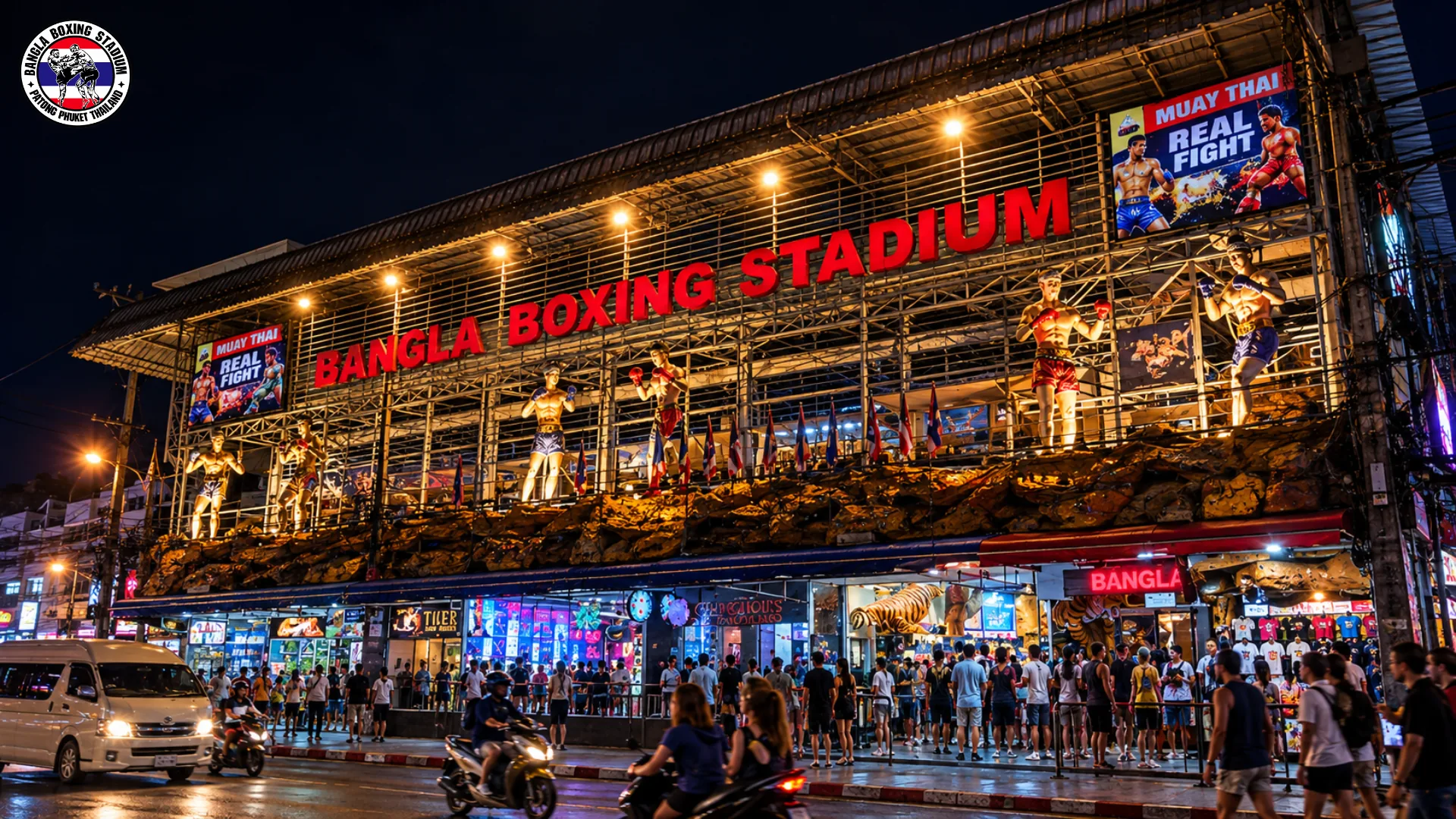
Watching authentic Muay Thai in person is one of the most exciting cultural experiences you can enjoy while visiting Phuket. While kickboxing events are common around the globe, nothing matches the raw sound, ceremonial beauty, and live energy of Thailand’s national sport inside an authentic Patong stadium. If you are comparing venues, our guide on where to watch Muay Thai in Phuket lists the main stadiums.
The table below outlines event schedules, seating categories, and fight night features at Bangla Boxing Stadium.
| Event Feature | Bangla Boxing Stadium Details |
|---|---|
| Fight Schedule | Every night, 7 days a week (Doors 8:00 PM, First bout 9:00 PM) |
| Fight Card Length | 8 to 9 professional bouts concluding around midnight |
| Stadium Seating Tier | 1,600 THB (Elevated amphitheater seating, includes free T-shirt) |
| Ringside Seating Tier | 2,000 THB (Front-row canvas seating, includes free T-shirt) |
| Special Bout Cards | Live MMA bouts featured every Wednesday and Saturday night |
Real Muay Thai Every Night at Bangla Boxing Stadium
Bangla Boxing Stadium sits in the heart of Patong, within walking distance of the main beach area. Located at 155/16 Phang Muang Sai Kor Road, directly behind Jungceylon Shopping Center and across from Banzaan Fresh Market, the venue hosts authentic Muay Thai cards every single night of the week. Traditional Muay Thai is the heart of every card, and mixed martial arts bouts join the program on Wednesday and Saturday nights. Doors open at 8:00 PM, and the evening card begins at 9:00 PM with 8 to 9 live bouts accompanied by ringside musicians and clear English commentary.
How to Reserve Ringside and Stadium Seats
Booking ahead secures your tickets for the night you want. Bangla Boxing Stadium offers two transparent seating tiers: elevated Stadium seats for 1,600 THB and front-row Ringside seats for 2,000 THB, with identical pricing whether you purchase at the box office or through the official Bangla Boxing Stadium tickets booking page at banglaboxingstadium.com. Every ticket includes a complimentary official stadium T-shirt to take home as a souvenir. The 900-seat amphitheater features open-air airflow with ceiling fans, four beer bars, snack counters, and an authentic Muay Thai gear shop to make your fight night complete.
Frequently Asked Questions About Muay Thai and Kickboxing
Can You Throw Elbows in Kickboxing?
No, elbow strikes of any kind are strictly illegal in standard kickboxing matches. Throwing a horizontal, slashing, or spinning elbow in a kickboxing bout results in an immediate penalty or disqualification from the referee. In contrast, elbows represent one of the most dangerous and celebrated offensive weapons in professional Muay Thai, used frequently during close-range exchanges and clinch battles.
Why Does Live Music Play During a Muay Thai Fight?
Live traditional Sarama music plays throughout every Muay Thai bout to guide the rhythm, pace, and fighting spirit of the athletes in the ring. The four-piece musical ensemble watches the striking exchanges closely to shape the stadium energy:
- Controlling Round Tempo: The musicians play slow, hypnotic rhythms in the opening rounds, gradually accelerating the tempo to mirror the rising action of the bout.
- Inspiring Aggression: When fighters enter intense exchanges or lock into heavy clinch battles, the quickening percussion urges both competitors to press forward.
- Preserving Stadium Heritage: Live acoustic instrumentation maintains an authentic Thai cultural atmosphere that distinguishes stadium fight nights from modern sports events.
What Fights Can You Watch at Bangla Boxing Stadium?
Bangla Boxing Stadium is built around Muay Thai. The stadium is dedicated to presenting authentic live Muay Thai cards every night, 7 days a week, keeping Thailand’s heritage alive in Patong. On Wednesday and Saturday nights, the venue adds special mixed martial arts bouts to the program, giving spectators an exciting look at multiple combat disciplines without altering standard Muay Thai traditions. Our guide to MMA and Muay Thai nights explains what changes on those cards.
Conclusion
Understanding the distinction in Muay Thai vs kickboxing enhances your enjoyment of world-class striking, whether you watch on a screen or from a stadium seat. While kickboxing offers blistering speed and crisp boxing combinations, Muay Thai delivers the complete power of eight limbs, devastating clinch control, and a rich cultural heritage shaped over centuries.
If you are spending your holiday in Phuket, nothing compares to witnessing the thud of real shin kicks and the drama of live Sarama music in person. Bangla Boxing Stadium in Patong welcomes international visitors every night of the week to experience genuine Thai boxing up close. Choosing a Ringside or Stadium ticket promises a memorable evening of authentic athletic tradition right in the vibrant heart of the island.