Key Takeaways
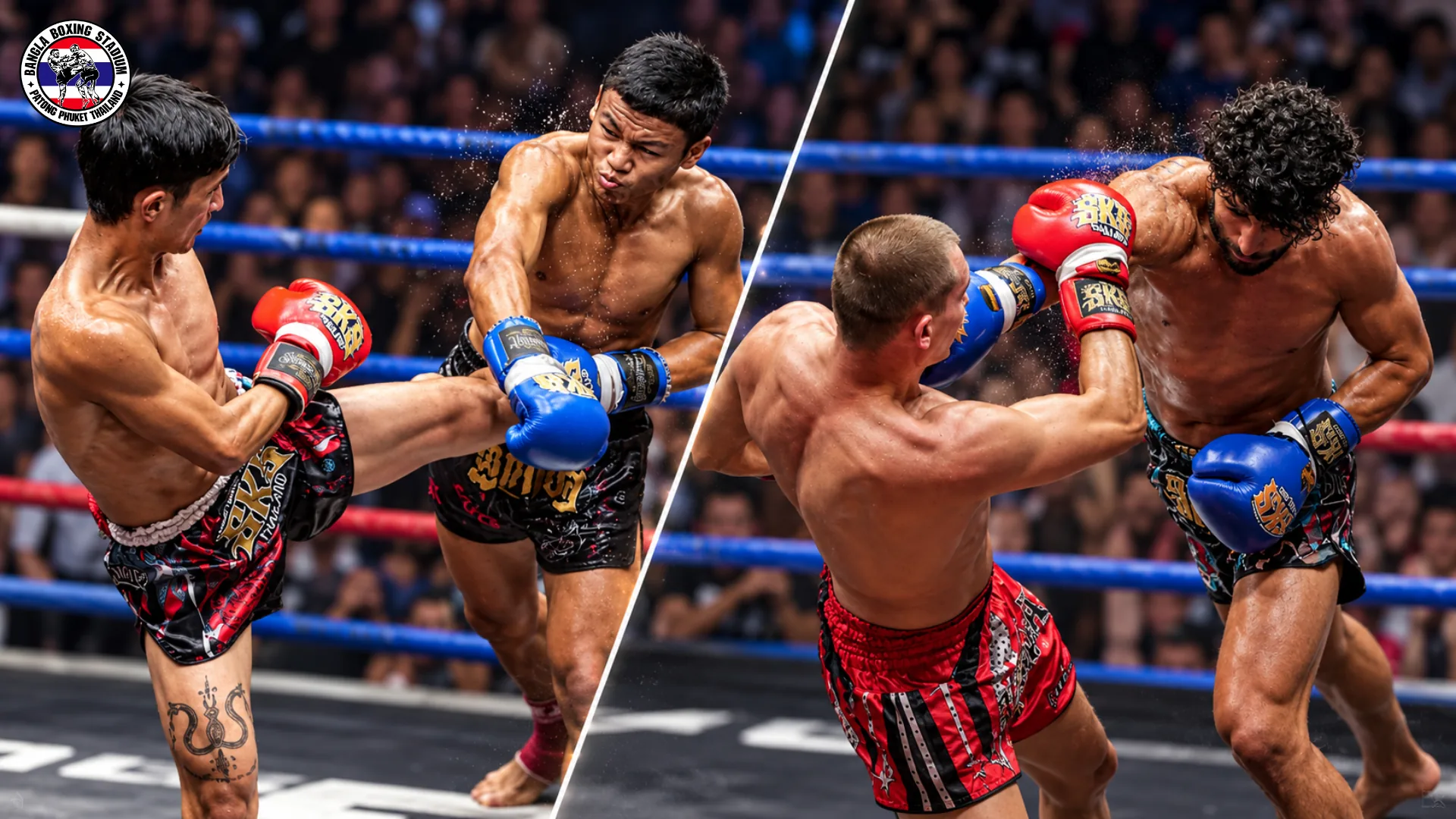
- Muay Thai vs boxing comes down to weapons. Boxing restricts all offensive action to two fists above the belt, whereas Muay Thai engages eight points of contact including punches, elbows, knees, and shin kicks.
- Referees in boxing separate clinches immediately, while Muay Thai referees allow continuous stand-up grappling to deliver close-range knees and off-balancing sweeps.
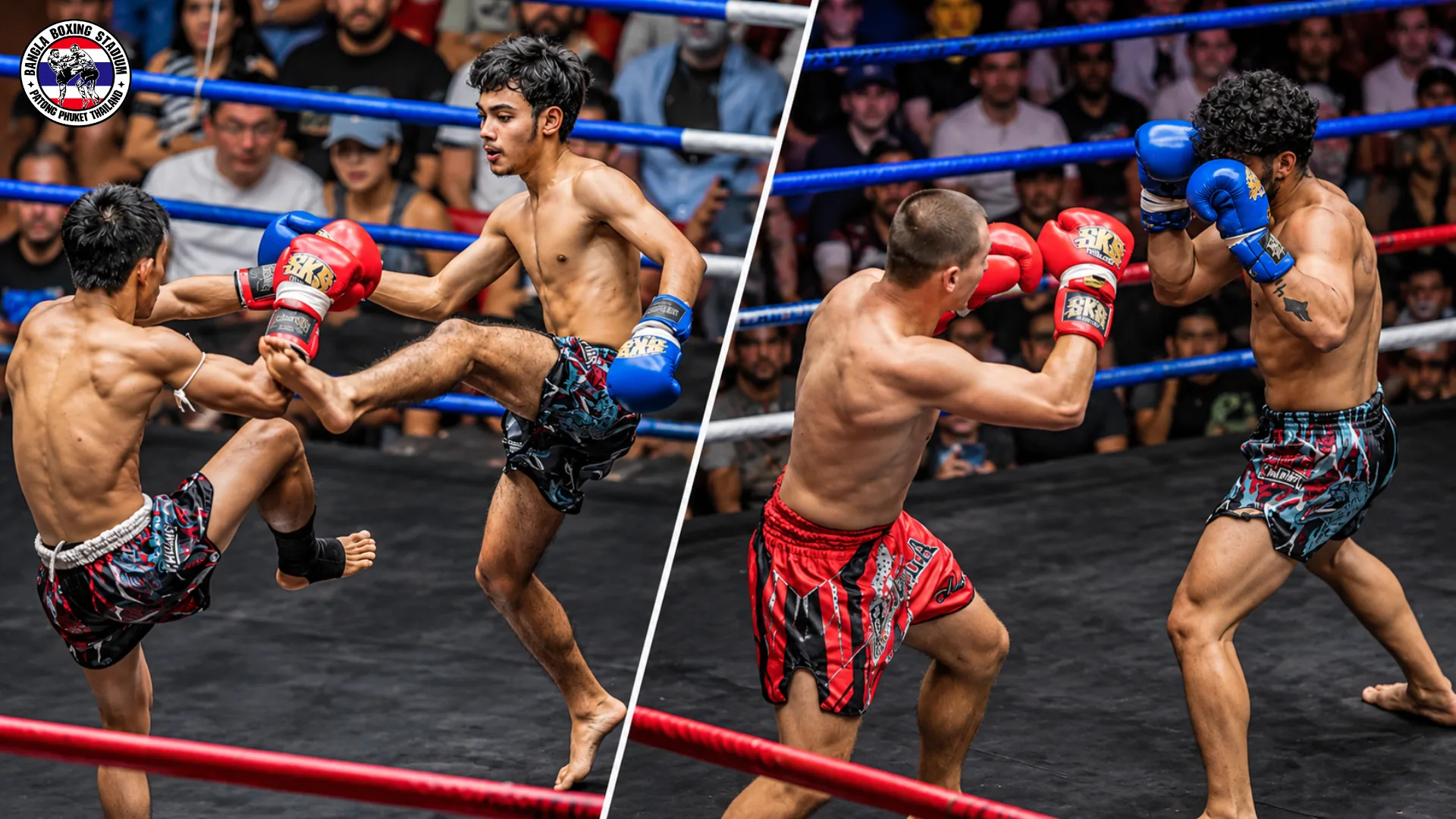
- Boxers lean into a bladed stance with head movement, while Thai boxers stand upright and square to check low kicks with their shins.
- Scoring in boxing rewards clean punching and round-by-round ring control, whereas Muay Thai scoring emphasizes clean damage, balance disruption, and later-round momentum.
- Bangla Boxing Stadium hosts authentic live Muay Thai fights seven nights a week in Patong, giving spectators ringside views of traditional ceremonies and full striking cards.
Combat sports fans familiar with Western boxing often encounter a whole new visual language when stepping into a traditional stadium in Thailand. Understanding Muay Thai vs boxing helps you recognise how two world-class striking disciplines approach timing, defense, and distance under entirely different rules.
Both arts demand peak physical conditioning, precision, and tactical discipline inside the ring. By exploring the core differences in legal strikes, grappling rules, and pacing, first-time spectators can fully appreciate the dynamic rhythm of live Thai boxing.
Table of Contents
- Key Takeaways
- The Main Difference Between Muay Thai and Boxing
- Muay Thai vs Boxing Weapons and Legal Strikes
- Clinching Rules in Muay Thai vs Boxing
- Muay Thai vs Boxing Stance, Footwork and Pacing
- Muay Thai vs Boxing Scoring and How Fights Are Won
- What Watching Muay Thai vs Boxing Live Feels Like
- Watch Muay Thai Live in Patong
- Frequently Asked Questions About Muay Thai and Boxing
- Conclusion
The Main Difference Between Muay Thai and Boxing
The main difference between Muay Thai and boxing is that boxing permits strikes only with padded fists above the waist, while Muay Thai allows strikes with punches, elbows, knees, and kicks. Boxing treats standing clinches as a break in action, whereas Muay Thai treats the clinch as an active scoring battleground.
These contrasting foundations shape every movement, defensive guard, and tactical choice inside the ring.
Two Fists Versus the Art of Eight Limbs
Western boxing channels every offensive combination through two gloved fists. Boxers train thousands of hours to master jabs, cross punches, hooks, and uppercuts delivered at precise angles to the head and torso. Defense relies on slips, shoulder rolls, and parries designed specifically around punch trajectories.
Muay Thai operates as the Art of Eight Limbs by incorporating two hands, two elbows, two knees, and two shins. Fighters can strike at long range with snapping teep push kicks, middle range with roundhouse kicks and punches, and zero range with slicing elbows. This broad arsenal forces athletes to defend every level of the body simultaneously.
Muay Thai and Boxing Rules Comparison at a Glance
Comparing the regulatory frameworks of both combat sports highlights why each discipline produces distinct movement patterns and ring strategies. The following breakdown outlines how key competition rules differ across professional bouts.
| Feature | Muay Thai | Boxing |
|---|---|---|
| Striking Weapons | 8 points (fists, elbows, knees, shins) | 2 points (fists only) |
| Clinching Rules | Permitted with active knees and sweeps | Prohibited; referee breaks immediately |
| Typical Bout Length | 5 rounds of 3 minutes (2-minute rest) | 4 to 12 rounds of 3 minutes (1-minute rest) |
| Primary Stance | Upright and square to check kicks | Bladed and low with forward head slip |
| Defensive Checks | Shin blocks against incoming kicks | Arm guards, shoulder rolls, ducking |
| Scoring Priority | Cumulative damage, kicks, knees, balance | Clean punching, defense, ring control |
Muay Thai vs Boxing Weapons and Legal Strikes
Striking mechanics separate boxing and Muay Thai into two distinct martial arts disciplines. The differing number of legal contact points fundamentally changes how athletes close distance and exchange damage.
Understanding how hands, legs, elbows, and knees operate provides a clear window into each sport’s combat geometry. The following breakdown highlights how legal strikes compare between both disciplines.
| Strike Category | Muay Thai | Boxing |
|---|---|---|
| Punching Techniques | Jabs, crosses, hooks, and overhands used to set up kicks | Complete punching system with complex angles, slips, and body hooks |
| Elbow Strikes | Fully legal at close range (slashing, downward, spinning) | Strictly prohibited and penalised as an illegal foul |
| Knee Strikes | Fully legal to the ribs, abdominal wall, and head | Strictly prohibited at all times |
| Kicking Techniques | Heavy roundhouse kicks with the shin and teep push kicks | Not allowed; kicking is a foul |
How Boxing Relies Exclusively on Hands and Punch Angles
Because boxers can only score with their fists, they develop sophisticated punching combinations, feints, and head movement. Athletes spend rounds setting traps with lead jabs to create openings for sharp straight rights and looping left hooks. Body punching plays a central role, targeting the liver and floating ribs to deplete stamina.
Without the threat of incoming kicks or knees, boxers can bend at the waist, dip under hooks, and roll along the ropes. This focus produces exceptional hand speed, head evasion, and close-quarters infighting with short hooks and uppercuts.
How Muay Thai Incorporates Elbows, Knees and Shin Kicks
Muay Thai attacks the opponent using bones that act like natural weapons. Roundhouse kicks generate immense power from hip rotation, striking with the dense bone of the lower shin rather than the foot. Low kicks target the thigh muscles to compromise mobility, while body kicks target the ribcage and arms.
At close quarters, fighters throw horizontal, downward, and upward elbow strikes with pinpoint accuracy. Knee strikes drive straight into the abdominal wall or curve across the ribs during infighting. Defending this multi-level assault requires fighters to keep their guard high while remaining ready to lift their shins.
Clinching Rules in Muay Thai vs Boxing
Grappling rules create one of the starkest contrasts between Western boxing and Muay Thai. Spectators accustomed to watching boxing often expect referees to intervene when fighters lock arms, but Muay Thai treats standing ties as a premier offensive zone.
How each sport handles close-range tie-ups determines whether the action pauses or intensifies. Below is how inside clinch mechanics and referee interventions differ.
| Clinch Dynamic | Muay Thai | Boxing |
|---|---|---|
| Official Status | Primary offensive zone for scoring strikes | Tactical foul; holding arms is an illegal infraction |
| Referee Intervention | Allowed to continue as long as combatants remain active | Referee steps in immediately to command a break |
| Permissible Strikes | Short elbows to the face, knees to the body, and off-balancing sweeps | No strikes permitted while wrapping arms or holding |
| Defensive Objective | Counter-collar tie, hip control, and posturing up | Reset distance, smother incoming punches, and recover stamina |
Why Western Boxing Referees Break Clinches Immediately
In Western boxing, grabbing or wrapping arms around an opponent serves primarily as a tactical defense to reset distance or recover from heavy exchanges. Referees actively step between fighters to ensure continuous hand-to-hand striking.
- Foul Classification: Boxing rules classify holding and pinning an opponent’s arms as an illegal infraction that can draw warnings or point deductions.
- Action Flow: Immediate breaks prevent extended stalemates and force fighters to re-engage with clean punches from open stances.
- Safety Protocol: Prohibiting inside wrestling reduces head clashes and accidental gouging while preserving the sport’s punch-only identity.
How Muay Thai Turns the Clinch into an Active Striking Battle
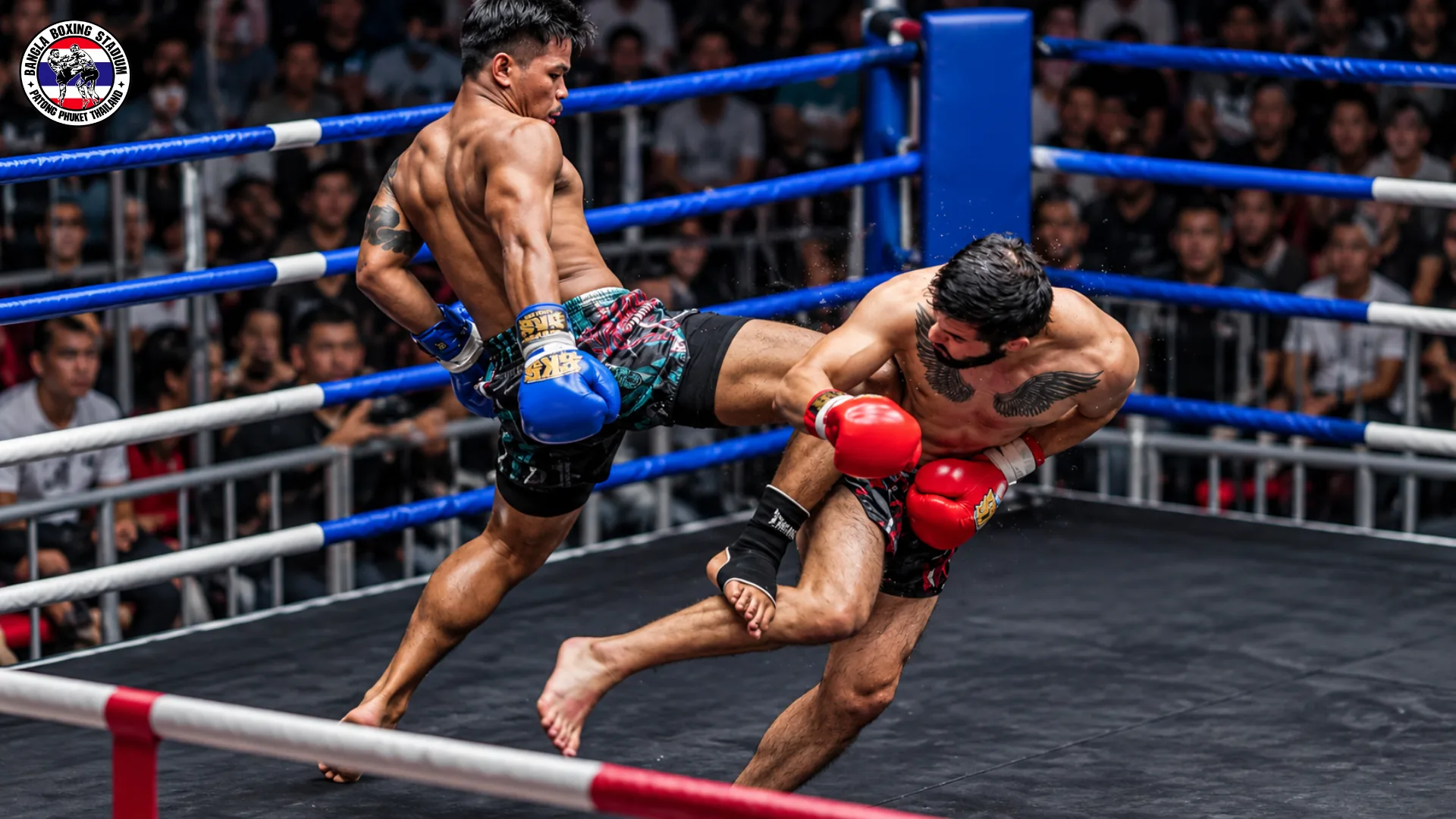
In Muay Thai, the clinch is an active wrestling discipline known as the plum. Fighters lock their hands behind an opponent’s neck or wrap their arms around the torso to control balance and posture. The fighter who controls the head can break their opponent’s base and pull them directly into upward knee strikes.
Referees allow the tie-up to continue as long as combatants maintain active offense. Fighters deliver short elbow strikes to the forehead, drive knees into the ribs, and use legal sweeps to dump an off-balance opponent to the canvas, while hip throws remain illegal.
Muay Thai vs Boxing Stance, Footwork and Pacing
A fighter’s stance reflects the specific threats they must defend against. The stance in boxing prioritizes upper-body mobility and linear reach, whereas the Muay Thai posture emphasizes lower-body defense and rotational balance.
These biomechanical adjustments influence how each sport flows from round to round. The table below outlines how posture, footwork, and tempo evolve during a bout.
| Biomechanical Element | Muay Thai | Boxing |
|---|---|---|
| Torso Alignment | Tall and square to face incoming strikes front-on | Angled and bladed to present a narrower target area |
| Center of Gravity | High with weight on back foot to keep lead leg light | Lowered with weight balanced for rapid lateral pivots |
| Head Movement | Minimal ducking to avoid rising knees and head kicks | Continuous slipping, bobbing, and weaving under hooks |
| Bout Pacing Arc | Deliberate opening rounds building to peak action in rounds 3 and 4 | High-cadence exchanges from round 1 across up to 12 rounds |
Why Boxers Stay Low and Angled While Thai Boxers Stand Tall
The contrasting threats of punches versus kicks dictate completely different body alignments and center-of-gravity placement.
- Target Profile: Boxers turn side-on with a bladed stance to present a narrow target and tuck their chin safely behind the lead shoulder.
- Kick Defense: Thai boxers stand square and upright so they can lift their lead leg instantly to check kicks with their shin bone.
- Weight Distribution: Boxing distributes weight evenly for rapid lateral pivots, while Muay Thai places weight on the back leg to keep the front foot light.
- Head Positioning: Dipping low works in boxing but exposes a fighter to devastating head kicks and rising knees in Muay Thai.
How Pacing Evolves from Measured Openings to Fast Later Rounds
Boxing bouts usually establish an active rhythm from the opening bell, with fighters trading jabs and establishing territory across up to 12 rounds. Because rounds are scored individually, conceding early rounds puts a boxer behind on scorecards immediately.
Traditional Muay Thai follows a five-round dramatic arc. Rounds 1 and 2 operate as a deliberate feeling-out process where fighters gauge timing, distance, and defensive reactions. The contest intensifies dramatically in Rounds 3 and 4 with heavy middle kicks and clinch battles, before reaching a strategic climax in Round 5.
Muay Thai vs Boxing Scoring and How Fights Are Won
Judging criteria dictate how fighters budget energy and select offensive combinations. While both sports use a 10-point must system, what earns points on the scorecards differs significantly between them.
Recognizing these judging priorities helps spectators understand why certain strikes alter the course of a match. Here is how scoring criteria compare across both ring sports.
| Scoring Factor | Muay Thai | Boxing |
|---|---|---|
| Judging Philosophy | 10-point must per round, judged with the whole fight in view | 10-point must system evaluating each round independently |
| Strike Value | Clean shin kicks, knees, and sweeps score higher than light punches | Clean, accurate punches to head and body |
| Round Weighting | In traditional Thai judging, rounds 3 to 5 usually decide the fight | Every round holds identical mathematical value on scorecards |
| Control Indicators | Maintaining steady composure and breaking opponent balance | Ring generalship, clean punching, and effective aggression |
Round by Round Clean Punching Versus Fight-Long Damage and Control
Boxing judges score each round as an isolated three-minute contest. The fighter who lands cleaner punches, shows better ring generalship, and makes the opponent miss typically wins the round 10-9. Every round carries identical mathematical weight toward the final decision.
Muay Thai judges also score each round, but traditional Thai judging reads the fight as a whole, emphasizing overall damage, balance, and dominance. A fighter who lands numerous light punches may still lose the round to an opponent who lands three heavy body kicks that knock them off balance. Knocking an opponent down or breaking their posture carries immense scoring influence.
Why Later Rounds Carry More Weight on Muay Thai Scorecards
Traditional stadium judging places decisive emphasis on the middle and championship rounds rather than the opening exchanges.
- Strategic Escalation: Rounds 1 and 2 serve as tactical preparation, allowing both combatants to find their rhythm without premature fatigue.
- Power Accumulation: Rounds 3 and 4 represent the peak scoring phase where fighters commit full power to kicks, knees, and clinch sweeps.
- Dominance Confirmation: Round 5 tests composure, where the leader demonstrates control while the trailing fighter must pursue a decisive finish.
What Watching Muay Thai vs Boxing Live Feels Like
Attending a live combat sports event offers sensory immersion that television broadcasts cannot replicate. While major boxing matches present stadium lights and walk-out production, traditional Thai boxing delivers an unbroken cultural ritual.
The rhythm of the arena creates a unique collective energy between fighters, referees, and the crowd. The breakdown below contrasts what spectators experience ringside.
| Atmosphere Element | Muay Thai | Boxing |
|---|---|---|
| Venue Environment | Intimate open-air stadium with immediate ringside proximity | Large indoor sports arenas or convention entertainment halls |
| Acoustic Background | Live traditional Sarama band playing continuous tempo changes | Recorded walk-out music and arena PA announcements |
| Pre-Fight Ceremony | Sacred Wai Kru Ram Muay dance honoring trainers and heritage | Fighter walk-out presentations with lights and ring entrances |
| Crowd Engagement | Communal rhythm reacting to thudding kicks and clinch action | Focused silence during tactical trades followed by sudden roars |
Arena Production Versus Traditional Ringside Atmosphere
Professional boxing cards are staged in large convention arenas or sporting halls. The venue remains quiet during technical exchanges, followed by sudden roars when a punch lands cleanly. Pyrotechnics, laser lighting, and recorded music introduce each headliner.
Live Muay Thai in Thailand delivers raw, ringside immediacy. Spectators sit close to the canvas where they can hear the resonant slap of shins connecting against ribs and the thud of leather gloves. The atmosphere blends sporting intensity with deep-rooted Thai traditions that have spanned generations.
Live Sarama Music and the Rhythm of Ringside Energy
Before every Muay Thai bout, fighters perform the sacred Wai Kru Ram Muay dance to pay respect to their teachers and gym. A live four-piece musical ensemble plays traditional Sarama music using a reed pipe, two drums, and bronze cymbals.
The band plays continuously throughout each three-minute round, adjusting its tempo to mirror the action inside the ropes. As exchanges heat up in Rounds 3 and 4, the drumming accelerates into a rapid cadence that drives the fighters forward and electrifies the stadium audience.
Watch Muay Thai Live in Patong
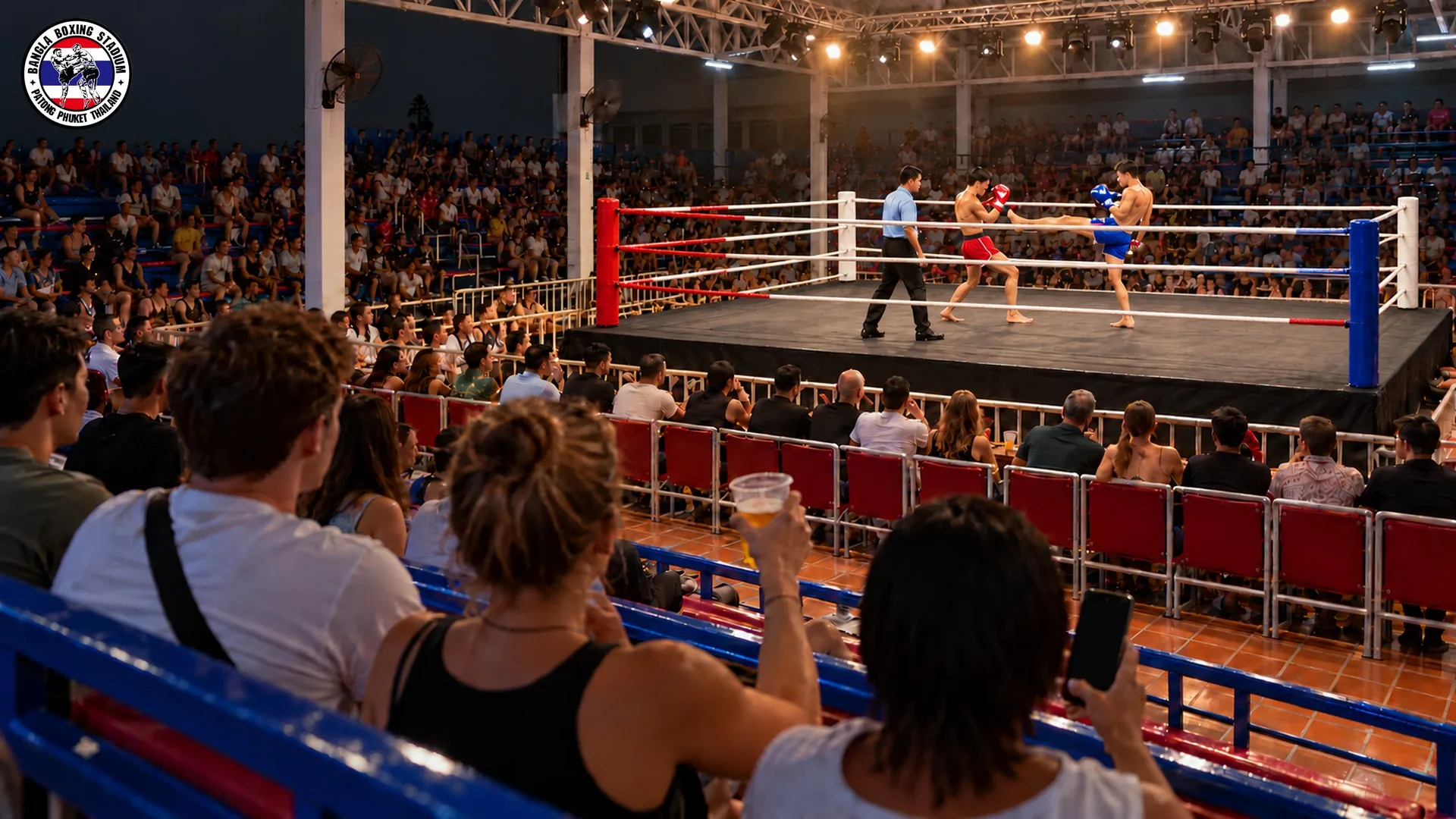
If you are visiting Phuket, Bangla Boxing Stadium offers an authentic fight night experience right in Patong. The stadium sits at 155/16 Phang Muang Sai Kor Road, directly behind Jungceylon Shopping Center and opposite Banzaan Fresh Market. Our guide to Bangla Stadium Patong walks through the venue, schedule, and seating zones.
The venue accommodates 900 spectators in an open-air amphitheater with ceiling fans, four beer bars, and snack stands. Fights run nightly, seven days a week, with doors opening at 8:00 PM and the first bout starting at 9:00 PM. Each card features 8 to 9 bouts accompanied by live Sarama music, the Wai Kru ritual, and English commentary.
| Event Feature | Bangla Boxing Stadium Details |
|---|---|
| Fight Schedule | Every night, 7 days a week (Doors 8:00 PM, First bout 9:00 PM) |
| Fight Card Length | 8 to 9 professional bouts concluding around midnight |
| Stadium Seating Tier | 1,600 THB (Elevated amphitheater seating, includes free T-shirt) |
| Ringside Seating Tier | 2,000 THB (Front-row canvas seating, includes free T-shirt) |
| Special Fight Cards | Live MMA bouts featured every Wednesday and Saturday night |
Tickets cost 1,600 THB for elevated Stadium seats and 2,000 THB for Ringside seats right against the ropes. Every ticket includes a free stadium T-shirt, with identical prices online and at the gate. You can book your Bangla Boxing Stadium tickets on the official website or purchase them at the box office before the fights begin.
Frequently Asked Questions About Muay Thai and Boxing
Can You Use Boxing Gloves in Muay Thai?
Both sports use padded gloves, and glove weight depends on the event rules and the fighter’s weight class. Muay Thai gloves have subtle structural differences. Muay Thai gloves incorporate more flexible wrist padding and a flatter palm profile to allow fighters to grip wrists and lock hands during clinch exchanges. Traditional boxing gloves are stiffer and shaped into a tighter fist curve to optimize wrist alignment for punching impact.
Why Do Muay Thai Fighters Stand Taller Than Boxers?
The difference in fighting stance stems from the defensive demands of each sport’s legal weapons.
- Shin Checking: Standing upright keeps the hips open and allows fighters to lift their lead leg instantly to block incoming middle and low kicks.
- Knee Defense: Leaning forward or bending at the waist leaves the head vulnerable to upward knee strikes and slicing elbows inside the pocket.
- Teep Execution: A tall posture places weight on the back leg, freeing the lead foot to fire fast push kicks to keep aggressive punchers at bay.
Can Spectators Watch Live Muay Thai Every Night in Phuket?
Yes, fight fans can watch live Muay Thai every night in Patong at Bangla Boxing Stadium. The venue hosts full professional fight cards seven days a week, featuring local and international fighters across 8 to 9 bouts. Matches begin at 9:00 PM and finish around midnight, providing an exciting evening activity right in the center of Patong. If you decide on the day, our guide to Muay Thai fights tonight explains door times and same-night booking.
Conclusion
Comparing Muay Thai vs boxing highlights how different rule sets create two distinct forms of striking mastery. Boxing refines upper-body head movement, footwork angles, and rapid punching combinations into a razor-sharp art form. Muay Thai expands the battleground into the Art of Eight Limbs, combining punches with devastating kicks, knees, and technical clinch grappling.
Neither discipline requires you to choose a favorite to appreciate what each art brings to combat sports. Watching live Muay Thai in Thailand provides an unforgettable cultural experience complete with live music, ring rituals, and full-contact striking. Securing a seat at a nightly stadium card lets you witness these athletic contrasts live from ringside.